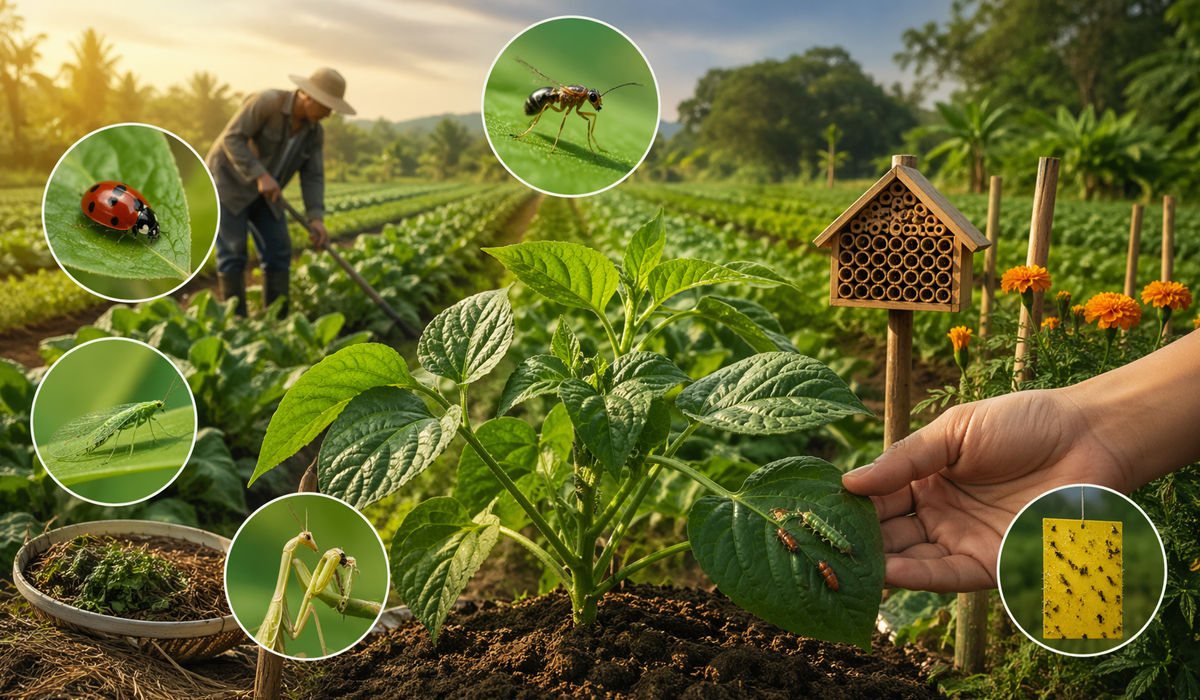
Environmentally friendly pest control for a healthier, more productive, and more sustainable modern agriculture for the future.

Modern agriculture currently faces increasingly complex challenges, ranging from climate change and declining soil quality to pest attacks that can threaten crop yields.
In an effort to maintain productivity, the use of chemical pesticides is still common, but this approach is slowly being abandoned due to its impacts on the environment and human health. Therefore, the concept of environmentally friendly pest control is becoming increasingly relevant and widely applied in today’s agriculture.
Basic Concepts of Environmentally Friendly Pest Control
Environmentally friendly pest control is an approach that emphasizes ecosystem balance in addressing crop pest infestations. Unlike conventional methods that rely on synthetic chemicals, this approach utilizes natural processes to control pest populations.
The main principle is to reduce dependence on chemical pesticides and replace them with more natural and sustainable methods. This aims to maintain the health of soil, water, and other organisms in the agricultural environment. Thus, agricultural systems can remain productive without damaging the surrounding ecosystem.
The Role of Natural Enemies in Pest Control
One of the most effective methods of environmentally friendly pest control is the use of natural enemies. Natural enemies are organisms that naturally prey on or control pest populations, such as predators, parasites, and certain microorganisms.
For example, insects like ladybugs and spiders can help reduce the population of small pests that damage crops. Furthermore, some bird species also play a role in controlling insect pests in agricultural fields.
By maintaining the presence of natural enemies, farmers can create a more stable and sustainable pest control system without having to rely on harmful chemicals.
Cultivation Techniques That Support Healthy Agriculture
In addition to utilizing natural enemies, cultivation techniques also play an important role in environmentally friendly pest control. One frequently used approach is crop rotation, which involves periodically changing the types of crops planted on a given plot to disrupt the pest’s life cycle.
Furthermore, the use of trap crops is also an effective strategy. Certain plants are planted to attract pests away from the main crop, thus minimizing damage.
Other techniques, such as the use of pest-resistant plant varieties, are also increasingly being developed in modern agriculture. This approach not only helps reduce pest infestations but also improves soil fertility and the sustainability of agricultural production.
Also Read: Expert Pest Control Services For Reliable And Long-Lasting Protection
Using Botanical and Natural Pesticides

In environmentally friendly pest control, botanical pesticides are a widely used alternative. These pesticides are made from natural ingredients such as leaves, seeds, or roots of plants that have anti-pest properties.
An example is the use of neem leaf or garlic extract, which are known to repel pests without harming the environment. In addition to being safer for humans and animals, botanical pesticides are also easily biodegradable, thus preventing soil and water pollution.
The use of these natural ingredients is becoming an increasingly popular solution because they can maintain ecosystem balance while protecting crops from pest attacks.
Environmentally friendly pest control is an important approach in modern agriculture that focuses on sustainability and ecosystem balance. By utilizing natural enemies, implementing appropriate cultivation techniques, and using botanical pesticides, farmers can control pests without harming the environment.